
eHealth for mental health
24 February 2026
Webinar highlights: How do we make interdisciplinarity work in mental health research
Interdisciplinarity in mental health research
A collection of experiences and lessons from 7 EU Mental Health projects
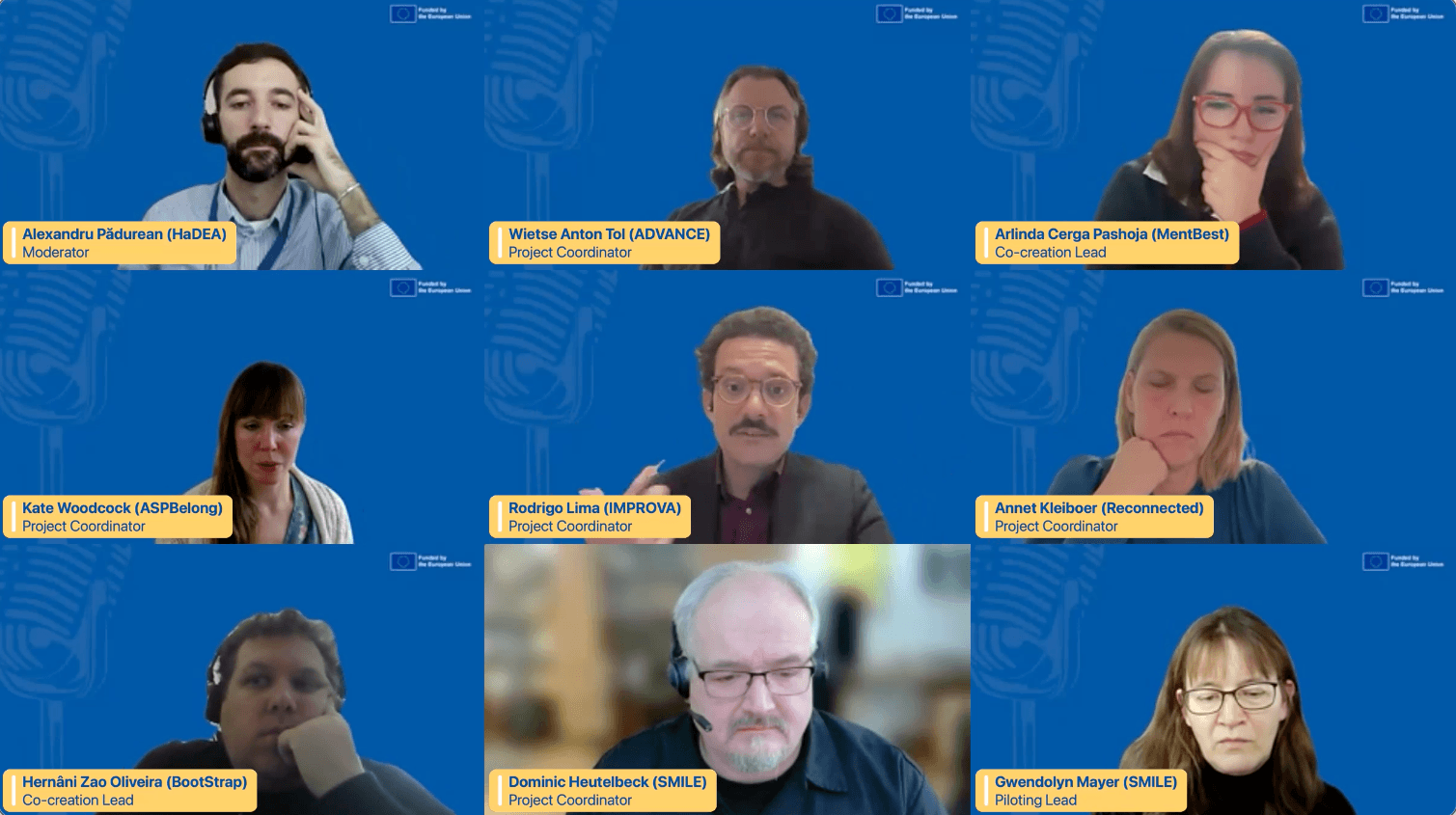
In her keynote presentation during the 7th Mental Health Dialogues on 24 February 2026, Dr. Barbara Regeer from the Vrije Universiteit Amsterdam, highlighted that interdisciplinarity is essential for mental health research, as complex lived realities cannot be captured by a single discipline.
Multiple perspectives are necessary, not optional. True understanding emerges from combining different ways of seeing and knowing.
However, interdisciplinary work is inherently challenging as it requires time, trust, and willingness to move beyond one's disciplinary identity. Dr. Regeer explained that effective collaboration depends on four key elements:
- Participation (active engagement across stakeholders)
- Knowledge integration (combining diverse forms of knowledge)
- Reflection (surfacing assumptions and building shared understanding)
- Iterative processes (non-linear, adaptive ways of working)
The following presents some of the highlights of the panel discussion during the 7th Mental Health Dialogues:
How did interdisciplinarity actually play out in your project, beyond what was planned or written in the proposal?
-
Wietse Anton Tol, ADVANCE coordinator: Broad disciplinary diversity can strengthen research projects but also increases the need for thoughtful integration. While dedicated work packages for co-creation and knowledge integration can provide a valuable structure—particularly when facilitated by contributors outside the traditional clinical research sphere, such as philosophers—the realities of interdisciplinary collaboration often diverge from what is envisioned in project proposals. In practice, bottom-up approaches, such as using shared boundary concepts like vulnerability and creating regular opportunities for interdisciplinary dialogue, are effective in fostering mutual understanding, challenging underlying assumptions, and building ownership across disciplines. Rather than seeking consensus or imposing a single overarching framework, successful integration recognizes and values disciplinary differences, adapting through ongoing negotiation and reflection. Overall, the experience highlights that interdisciplinary collaboration is an iterative and dynamic process, requiring flexible, responsive integration strategies rather than rigid, prescriptive plans.
- Arlinda Cerga Pashoja, Co-creation lead, MentBest: In practice, interdisciplinarity rarely unfolds as neatly as envisioned in project proposals. What begins as a carefully orchestrated plan often evolves into a more adaptive, emergent process—more akin to jazz than a Mozart symphony—where meaningful collaboration develops in the spaces between formal structures. The inclusion of co-creators, practitioners, community members, and system-level partners broadens projects beyond academic perspectives, grounding them in real-world contexts while introducing new methodological and practical tensions. A recurring challenge is balancing disciplinary depth and methodological rigor with contextual complexity and lived experience, requiring ongoing negotiation rather than fixed solutions. Productive collaboration depends on openly acknowledging these tensions, creating space for reflection, and recognizing that moments of disagreement can strengthen decision-making and outcomes. Through intentional boundary-crossing practices, such as creative workshops, joint authorship, and open dialogue, interdisciplinary teams build the trust needed to continuously adapt and align their work. Ultimately, the experience suggests that "productive messiness" is not a sign of failure but a defining feature of successful interdisciplinary innovation.
- Kate Woodcock, ASP-Belong coordinator: The project was transdisciplinary by design, integrating psychology, creative arts, technology, and industry expertise to develop a digital intervention that could not exist without contributions from all sectors. Rather than treating transdisciplinarity as a separate objective, collaboration focused on making the project work in practice. A key challenge was aligning the different rhythms of academia and industry, as initial expectations of synchronized workflows proved unrealistic and required continuous adjustment. Although partners shared an overarching vision, disciplinary and sectoral perspectives led to different interpretations, making ongoing dialogue, clarification, and realignment essential. Instead of relying on formal integration strategies, collaboration evolved through iterative cycles of identifying differences, negotiating shared understanding, and adapting to changing circumstances. Overall, the project demonstrated that when transdisciplinarity is foundational, success depends less on predefined structures than on continuous alignment, adaptive collaboration, and shared problem-solving.
What tensions, trade-offs, or behaviors emerged when working across disciplines in your project? Is there anything that you personally or institutionally had to unlearn or give up in order for interdisciplinarity to work?
-
Dominic Heutelbeck, SMILE Coordinator and Gwendolyn Mayer, Piloting Lead: The project brought together highly diverse disciplines—including software development, game design, and psychology—highlighting that interdisciplinarity is not automatic but a process of learning and adaptation. Early collaboration revealed that differences extended beyond methods and terminology to fundamentally different definitions of success, with psychology emphasizing scientific rigor and large-scale evidence, while technical disciplines prioritized iterative development and practical application. Aligning these perspectives required empathy, perspective-taking, and a willingness to reconsider traditional ways of working. Tensions were particularly evident in balancing the strict ethical and methodological requirements of clinical research with the flexibility needed for co-creation and agile development, making it impossible to fully define all processes in advance. As a result, the project moved away from the ideal of perfectly controlled data in exchange for deeper insights into real-world development, interdisciplinary collaboration, and innovation. Overall, the experience demonstrated that successful transdisciplinary research depends on continuously negotiating the balance between rigor and flexibility while redefining both processes and outcomes across disciplines.
-
Rodrigo Lima, IMPROVA Coordinator: The project was multidisciplinary by design, bringing together expertise from fields such as epidemiology, psychiatry, informatics, education, and ethics. Despite a well-developed proposal, partners entered the project with different understandings of its goals, concepts, and methodological approaches, demonstrating that early alignment and shared understanding cannot be taken for granted. Effective collaboration required continuous negotiation across disciplinary perspectives, while communication was further complicated by differences in disciplinary language, culture, and English proficiency, making inclusive participation a key priority. In-person meetings proved especially valuable for building shared understanding and strengthening collaboration. The project also had to balance co-creation with adolescents alongside technical development through iterative workflows that rapidly translated qualitative insights into design decisions, requiring flexible adaptations of traditional research processes. Interdisciplinarity extended beyond intervention development into the integration of effectiveness, implementation, economic, and social impact evaluations, as well as exploitation planning, all of which demanded ongoing coordination across diverse perspectives. Overall, the experience highlighted that successful interdisciplinary research depends on continuous alignment, inclusive communication, and the flexibility to adapt methods and timelines as the project evolves.
-
Hernâni Zao, Co-creation Lead, BootStrap: Communication emerged as a central challenge in interdisciplinary collaboration, as key concepts such as user and stakeholder were often understood differently across disciplines. Establishing a shared conceptual language and aligning expectations around what constitutes project success—and what each discipline stands to gain from participation—proved essential for fostering engagement and collaboration. The project's co-creation approach, which actively involved adolescents in the design process through gamification, highlighted the ongoing tension between scientific rigor and user engagement, demonstrating that user feedback can fundamentally improve the relevance and usability of interventions. Flexibility was therefore critical, as rigid adherence to predefined structures and timelines often limited responsiveness and required teams to reconsider what success looked like in practice. A particularly valuable strategy was involving partners from different work packages directly in co-creation activities, enabling them to experience stakeholder interactions firsthand. This not only strengthened interdisciplinary understanding and commitment but also helped reduce disciplinary power imbalances by elevating user perspectives. Overall, the experience showed that co-creation is more than a research method—it is a powerful mechanism for aligning disciplines, redistributing influence, and supporting successful transdisciplinary collaboration through shared language, adaptive working practices, and meaningful engagement with end users.
- Annet Kleiboer, Reconnected Coordinator: The project brings together diverse disciplines—including psychology, psychiatry, computer science, and complexity science—yet interdisciplinary collaboration has developed relatively naturally in practice. A key reason is the strong relational foundation among partners, whose prior experience of working together has fostered trust, shared understanding, and a common vision. Rather than relying on formal integration structures, collaboration has been supported by openness, mutual respect for expertise, a willingness to collaborate as equals, and the absence of disciplinary dominance. At the same time, the project illustrates how quickly interdisciplinarity can weaken when these conditions are absent, as limited communication, lack of shared purpose, or insufficient recognition of expertise can lead to frustration, disciplinary silos, and reduced innovation. By maintaining a low-hierarchy culture in which all perspectives are valued, the project demonstrates that successful interdisciplinarity depends less on formal processes than on strong relationships, trust, equality, and a collaborative culture built around shared goals.
If you were designing a new mental health project today, what is the one concrete intervention you would build in to strengthen interdisciplinarity? And what existing practice would you stop or remove to make space for it?
-
Wietse Anton Tol, ADVANCE Coordinator: The project highlighted that meaningful interdisciplinarity requires sustained effort over time rather than short-term integration activities. Continuous use of shared boundary concepts, such as equity, can effectively foster dialogue and integration when applied through bottom-up, iterative processes, whereas top-down approaches based on overarching theories may feel imposed and discourage engagement. A recurring challenge was the tension between fixed project designs and adaptive co-creation, as research proposals often define objectives and methods too early to allow stakeholders to meaningfully shape research questions and methodologies. Greater flexibility in project design is therefore essential for successful transdisciplinary collaboration. In-person interactions also proved invaluable for building relationships, strengthening dialogue, and developing shared understanding, despite the ongoing trade-off between investing time in collaboration and delivering project outputs. The experience further emphasized that interdisciplinary integration should not be viewed as a secondary or "soft" activity but recognized as a core project outcome through dedicated deliverables and accountability mechanisms. Overall, the findings suggest that successful transdisciplinary research depends on long-term dialogue, flexible project design, meaningful co-creation, and formal recognition of integration as a central component of the research process.
-
Arlinda Pashoja, Co-creation Lead, MentBest: Successful interdisciplinarity should be intentionally designed from the proposal stage by selecting disciplines that genuinely address the project's needs, while also recognizing the value of practice-based and lived experience expertise. Early reflection can help avoid both tokenistic interdisciplinarity and disciplinary overload by ensuring that diverse perspectives are meaningfully integrated rather than simply represented. A formal interdisciplinary onboarding process can establish shared understanding from the outset by clarifying disciplinary approaches, terminology, expectations, and success criteria, thereby reducing misunderstandings later in the project. Equally important are dedicated interdisciplinary spaces, such as co-creation labs, where researchers, practitioners, and people with lived experience can collaborate beyond routine reporting. Regular interactions of this kind improve alignment across work packages, reduce duplication and late-stage redesign, and strengthen long-term partnerships and exploitation opportunities. Achieving this requires a deliberate reallocation of time and resources, replacing lengthy reporting meetings with asynchronous updates to protect time for meaningful collaboration. Overall, the experience demonstrates that effective interdisciplinarity depends not simply on assembling diverse participants, but on intentionally designing the structures, processes, and collaborative spaces that enable integration to occur.
-
Rodrigo Lima, IMPROVA Coordinator:The project highlighted the importance of investing in early-stage alignment to establish a shared understanding across disciplines, with structured seminars and dedicated integration sessions providing a common foundation for collaboration by aligning concepts, goals, and approaches. Beyond individual projects, the experience points to the need to institutionalize interdisciplinarity through formal frameworks, guidance, and training, much like existing requirements for ethics or data management. Such support could promote greater consistency across projects, help teams navigate common interdisciplinary challenges, and reduce reliance on individual experience or the presence of a dedicated interdisciplinarity expert. As interdisciplinary collaboration becomes an increasingly common expectation in research funding, stronger institutional support mechanisms are needed to complement project-level efforts. Overall, the findings suggest that successful interdisciplinarity depends not only on early alignment within projects but also on broader system-level frameworks that enable and sustain effective collaboration.
-
Prof. Dr. Dominic Heutelbeck, SMILE Coordinator and Prof. Dr. Gwendolyn Mayer, Piloting Lead, SMILE: The project emphasized that co-creation should be a genuinely interdisciplinary process, with all disciplines actively engaging with end users rather than relying on siloed forms of participation. Because disciplines often differ in how they define success and approach their work, making these differences explicit from the outset is essential for reducing misunderstandings and fostering effective collaboration. Interdisciplinary teams also tend to default to familiar methods and practices, highlighting the importance of coordinators who can challenge established ways of working, encourage new approaches, and facilitate alignment across disciplines. This requires coordinators to take a proactive role, particularly in the early stages of a project, intervening where necessary to prevent future friction and build shared understanding. Cross-disciplinary awareness is therefore a key coordination skill, enabling effective mediation between different perspectives and working styles. Overall, the experience demonstrates that successful interdisciplinary collaboration depends on inclusive co-creation, intentional coordination, and the early alignment of both project goals and disciplinary approaches, rather than allowing integration to emerge passively.
- Kate Woodcock, ASPBelong Coordinator: The project underscored the importance of investing in early alignment by bringing all partners together as soon as the consortium is established to build a shared understanding from the outset. Initial discussions should focus not only on project objectives but also on developing a common vocabulary, clarifying disciplinary contexts, and explicitly addressing how the team will work together. Dedicated onboarding sessions can provide a strong foundation for collaboration, while external facilitation offers additional value by bringing neutrality, expertise in interdisciplinary processes, and the ability to surface hidden assumptions and structure productive dialogue. Drawing on experience from previous projects, such facilitated sessions can accelerate mutual understanding, reduce early misunderstandings, and allow teams to focus on building collaborative relationships before becoming absorbed by project deliverables. Overall, the findings suggest that the way a project begins has a lasting influence on interdisciplinary collaboration, highlighting the value of intentional early design, shared onboarding, and, where possible, external expertise to support integration.
Important key takeaways
-
Build a shared vision from the proposal stage: Early co-development of a common vision creates shared understanding, strengthens commitment, fosters ownership, and supports collaboration throughout the project.
-
Invest in early alignment: The proposal phase is a critical opportunity to establish common goals and ways of working, even though it requires substantial collaboration before funding is secured.
-
Recognize and address power dynamics: Interdisciplinary collaboration is shaped not only by disciplinary differences but also by inequalities in prestige, funding, publication cultures, policy influence, and communication styles.
-
Create equitable and inclusive collaboration: Actively value diverse forms of expertise—including co-creators and non-academic partners—while ensuring that technical language or dominant disciplines do not marginalize other perspectives.
-
Treat interdisciplinarity as both a methodological and social challenge: Successful collaboration depends on continuous attention to relationships, trust, equity, mutual recognition, and shared decision-making, not just knowledge integration.
Collective sense-making
-
Ann-Marie Küchler, Digital mental health expert, IMPROVA: Interdisciplinarity is a continuous learning process that extends far beyond bringing together diverse disciplines. It requires sustained effort to build a shared language and common mental models, recognizing that familiar concepts and terminology may carry different meanings across fields. Effective collaboration depends on intellectual humility, patience, and a willingness to ask questions, explain disciplinary perspectives, and learn from one another. Differences in timelines, methodologies, and ways of working inevitably create challenges, making empathy, mutual respect, and an understanding of each other's constraints essential for successful collaboration. While interdisciplinarity enables more holistic and robust approaches to complex challenges such as mental health, meaningful integration does not occur automatically; it requires intentional planning, structured interactions, and, where possible, dedicated roles to facilitate integration throughout the entire project lifecycle. Regular interdisciplinary meetings, continuous feedback, and co-creation processes help sustain collaboration, while ongoing attention to power dynamics and inclusion ensures that all perspectives are valued. Ultimately, trust functions as the hidden infrastructure of interdisciplinary work, and investing in relationships through face-to-face meetings and informal interactions strengthens collaboration, engagement, and collective learning. The experience highlights that interdisciplinarity is both a technical and relational practice, becoming most effective when supported by trust, structure, and continuous adaptation.
-
Adam Barnard, Theater Director, ASPBelong: Interdisciplinary exchange across projects provides valuable opportunities for collective learning by allowing researchers to step outside their own projects, recognize shared challenges, and reflect on common experiences. These discussions reinforced that successful interdisciplinary collaboration is shaped by differences in epistemic cultures, communication styles, and working rhythms, while also highlighting the distinction between interdisciplinarity—collaboration across disciplines—and transdisciplinarity, which additionally involves collaboration across sectors and societal actors. Although transdisciplinary approaches can generate particularly innovative outcomes, they are inherently complex and require continuous adaptation as projects evolve beyond their original proposals. Rather than attempting to eliminate the "noise" created by diverse perspectives, expectations, and success criteria, effective collaboration embraces this complexity as a source of creativity and innovation. Importantly, many interdisciplinary challenges only become visible when projects encounter their first major obstacles, demonstrating that early preparation alone is insufficient. Sustained collaboration therefore depends on ongoing humility, curiosity, and a willingness to question assumptions, learn from others, and remain genuinely interested in different perspectives. While ideals such as continuous reflective dialogue may not always be fully achievable in practice, they provide an important direction for collaboration. Overall, the experience suggests that interdisciplinarity is most rewarding when it is approached with openness, flexibility, and a shared commitment to learning from difference.
Attended by around 95 participants consisting of researchers, practitioners, people with lived experiences, association representatives, and policy-makers, the interactive session has gathered valuable inputs both from the panelists and the attendees.
Improve: Dr. Rodrigo Antunes Lima, Sant Joan de Déu

"Mental Health Dialogues" is an initiative of 7 big EU Horizon Europe projects under boosting mental health in Europe in times of change (HORIZON-HLTH-2022-STAYHLTH-01-01-two-stage), namely ADVANCE, ASP-belong, Boostrap, Improva, Mentbest, Reconnected, and SMILE. This is the first of a 4-year joint-webinar project with the aim to provide synergy among like-minded mental health research serving Europe and beyond.
Contact:
Joyce Anne Quinto
Project and Communications Manager
joyce.quinto@sund.ku.dk
Topics
More stories
Digital Applications in Mental Health.
Webinar highlights: Digital Applications in Mental Health
Vulnerable groups?
Webinar highlights: How to reach vulnerable groups in mental health research
Co-creation in mental health research
Webinar highlights: How do we get co-creation right in mental health research?
Mental health stigma